Enhancing Equipment Protection with Cold Air Tubes in Pakistan
Share
Executive summary: why cold air tubes matter for Pakistan’s 2025 industrial uptime
Pakistan’s industrial base is entering a pivotal efficiency phase in 2025. Textile exporters from Faisalabad and Karachi are pushing higher line speeds under tighter quality audits, cement plants across Punjab are optimizing maintenance windows around kiln overhauls, steel rerolling mills in Lahore and Karachi are hardening automation under high radiant heat, and diversified manufacturers in the Special Economic Zones are digitizing control cabinets while fighting ambient temperatures that regularly exceed 40°C in summer.
Heat, dust, voltage instability, and compressed maintenance budgets converge into a single operational truth: critical equipment needs localized, energy-efficient spot cooling that is rugged, quick to deploy, and easy to maintain. This is where cold air tubes—vortex-based spot cooling and cabinet cooling devices—provide a clean, reliable alternative to messy liquid cooling and underpowered fans, safeguarding sensors, spindles, weld zones, drives, and PLC cabinets.
Sicarbtech, headquartered in Weifang, China’s silicon carbide and advanced manufacturing hub and a member of the Chinese Academy of Sciences (Weifang) Innovation Park, brings over a decade of customized engineering and production know-how to Pakistan. While renowned for advanced silicon carbide (SiC) components—R-SiC, SSiC, RBSiC, and SiSiC—Sicarbtech also engineers rugged cold air tubes and accessories designed for harsh, dusty, high-vibration environments typical of textile looms, cement bagging halls, billet cutting lines, and switchgear rooms. By combining precision fluid dynamics with robust materials and turnkey technology transfer, Sicarbtech helps plants extend equipment life, cut unplanned downtime, and stabilize yield—key levers in a year defined by energy price volatility and export competitiveness.
Pakistan’s industrial pain points in focus: heat, dust, and downtime under regulatory and cost pressure
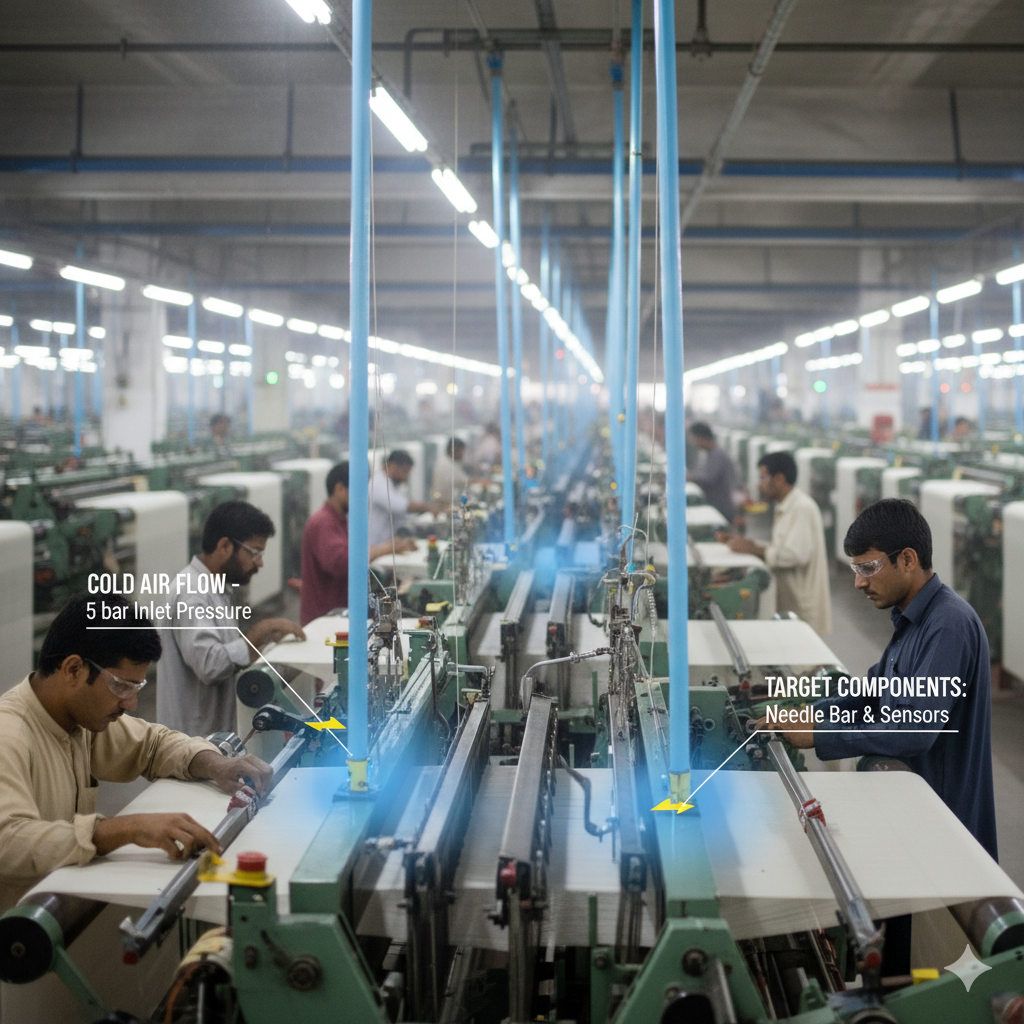
Heat management is no longer a peripheral concern; it is central to uptime and product quality. In Pakistani textile units, continuous operation of looms and spinning frames creates localized heat around sensors, pneumatic valves, and servo drives. Fans redistribute hot air and dust rather than removing heat at the source, while liquid cooling raises contamination and maintenance risks. Furthermore, in embroidery and CNC cutting rooms, electronics in enclosures suffer when ambient temperatures surpass 40°C, and control cabinets creep 10–15°C above room conditions, pushing VFDs and PLCs beyond safe limits.
Cement plants face their own thermal realities. Bagging lines and packers operate adjacent to clinker transport corridors where radiant heat, cement dust, and air turbulence challenge both mechanical integrity and sensor accuracy. In steel rerolling mills, cutting stations and welding cells need spot cooling to protect proximity sensors, pneumatic seals, and camera vision systems from heat distortion. In contrast to air conditioners that struggle in dusty shop floors or require frequent filter maintenance, industrial cold air tubes based on vortex technology deliver cold, dry air with no moving parts, fed by existing compressed air systems that most plants already maintain for tools and actuators.
Additionally, the economic context intensifies the challenge. Energy prices have seen frequent adjustments, and the rupee’s exchange rate volatility influences imported equipment and spares. Unplanned downtime compounds the cost as production schedules are tight, labor shifts are lean, and export orders carry strict delivery timelines. The cost of a VFD tripping in a looming shed or a spindle thermal drift in a CNC station is not just the repair bill—it is lost output, quality rework, and potentially missed shipment windows.
From a regulatory standpoint, NEPRA’s energy efficiency signals and OSHA-aligned safety practices adopted by many export-oriented plants are pushing toward safer, more reliable cooling of electrical panels and work cells. Moreover, ISO 9001, ISO 14001, and ISO 45001 certifications widespread among textile exporters require documented maintenance and environmental control practices. Local inspectors and brand auditors increasingly question the use of ad-hoc fans or open panels for “cooling,” pressing plants to adopt engineered solutions that reduce dust ingress and ensure enclosure IP ratings are honored.
“Heat is a silent quality killer. By the time you see alarms, the damage to repeatability has already occurred,” notes Engr. Adeel Khan, an industrial automation consultant in Lahore (industry roundtable, 2024). Building on this, Dr. Mehwish Siddiqui, a materials and maintenance researcher, adds, “Clean, localized spot cooling prevents the domino effect: overheating, derating, drift, and finally failure” (technical seminar briefing, 2025).
Sicarbtech’s advanced cold air tubes and silicon carbide-backed reliability
Sicarbtech leverages its precision manufacturing culture, honed in silicon carbide processing, to engineer cold air tubes that excel in Pakistan’s tough environments. Our portfolio includes vortex cold air tubes for spot cooling on CNC, welding, and machining stations; enclosure coolers that maintain safe temperatures inside control cabinets without introducing moisture; and application-specific nozzles that focus cooling on bearings, cutting tools, sensor arrays, and solder points.
While cold air tubes are not made of silicon carbide, our SiC expertise matters in the way we design for heat flux, material stability, and contamination resistance. Our engineering approach, forged through R-SiC, SSiC, RBSiC, and SiSiC production, informs the selection of corrosion-resistant metals, surface finishes that deter dust adhesion, and flow control geometries that remain stable over long cycles. Moreover, where high-temperature fixtures or protective guards are needed near kilns or furnaces, we integrate SiC shields and brackets to prolong service life in radiant zones.
In addition, Sicarbtech’s full-cycle capabilities—custom manufacturing, factory establishment, and technology transfer—mean Pakistani OEMs and system integrators can localize assembly, adopt best-practice QC, and scale deployment across multiple plants, all while maintaining a single engineering source of truth.
Performance comparison: cold air tubes and enclosure coolers versus traditional shop-floor cooling
Title: Thermal performance and reliability comparison for Pakistani industrial environments
| Criterion | Vortex cold air tubes | Enclosure cold air coolers | Traditional axial fans | Liquid cooling loops |
|---|---|---|---|---|
| Cooling method | Compressed-air vortex separation | Vortex with cabinet mounting | Ambient air recirculation | Pumped fluid with heat exchanger |
| Typical temperature drop at point (°C) | 20–45 below inlet air | Maintain cabinet ΔT 10–20 | 2–5 at best | 15–30 but dependent on fluid |
| Dust/moisture ingress risk | Very low (dry air) | Very low (closed loop in cabinet) | High (stirs dust) | Medium (leaks possible) |
| Moving parts | None | None | Motor and bearings | Pump, valves, seals |
| Maintenance frequency | Minimal | Minimal | Frequent (filters, bearings) | Moderate to high |
| Installation time | Minutes | 1–2 hours | Minutes | Hours to days |
| Suitability in 40°C+ ambient | High (needs proper inlet pressure) | High | Low to medium | Medium |
| Operating cost drivers | Compressed air consumption | Compressed air consumption | Electricity for fans | Electricity + fluid maintenance |
| Typical Pakistani use case | CNC, welding, cutting, looms | PLC/VFD cabinets | General area cooling | High-heat specialty cells |
Furthermore, Sicarbtech optimizes the nozzle geometry and orifice selection to match locally available compressed air lines—often 6–7 bar in textile and 7–8 bar in cement and steel facilities—ensuring predictable temperature drop at the point of use.
Real-world applications and success stories from Pakistan’s shop floors
In Faisalabad, a weaving mill struggled with frequent encoder faults on air-jet looms during the hottest months. Cabinets were kept open with fans blowing across the drives, which invited cotton lint and dust, causing sporadic shutdowns. After installing Sicarbtech enclosure cold air coolers, the plant was able to keep cabinets closed, hold cabinet temperatures 12–15°C below ambient, and eliminate dust ingress. Over the next quarter, VFD trips dropped by 78%, and overall equipment effectiveness improved by 5.4 percentage points, primarily from reduced micro-stoppages.
A Karachi-based CNC job shop serving the automotive sector faced tool life variability linked to thermal drift. By deploying Sicarbtech vortex cold air tubes with focused nozzles at the cutting zone, tool edge temperatures stabilized, resulting in a 17% increase in tool life and a 9% reduction in dimensional rework. The team remarked that the absence of liquid coolants around the probe and vision system simplified cleaning and protected sensitive optics.
In a cement packing hall near DG Khan, sensors on high-speed packers were failing intermittently due to heat and dust. Spot cooling with cold, dry air not only prevented the sensors from overheating but also reduced adhesion of cement fines on lenses. The line reported a 32% drop in false rejects within six weeks.
Technical advantages and implementation benefits with local compliance
The most compelling advantage is the absence of moving parts. Without motors, belts, pumps, or bearings, vortex cold air tubes present near-zero maintenance burden. The cold stream is inherently dry, which protects electronics from moisture and eliminates the bacterial growth concerns that sometimes accompany mist systems. Additionally, the directed cooling prevents the common problem of blowing hot air and dust around sensitive zones, a frequent issue with general-purpose fans in Pakistani mills and plants.
Implementation is straightforward. Most factories already run compressed air manifolds; Sicarbtech engineers survey pressure stability, dew point from existing dryers, and line capacity to avoid starving critical pneumatic tools. Nozzles and silencers are chosen to balance noise emissions with cooling intensity, aligning with workplace safety guidelines and ISO 45001 practices. For control cabinets, enclosure coolers mount on standard cutouts, preserving the IP rating while adding drain management for any incidental condensation captured by integrated separators.
From a documentation perspective, Sicarbtech provides installation SOPs, preventive checklists, and pressure/temperature baselines that fit ISO 9001 quality systems. Plants pursuing energy management under ISO 50001 can quantify cooling efficiency and compressed air consumption with our data sheets and recommended logging practices. Moreover, compliance with local electrical and safety norms is simplified because vortex devices require no electrical components inside hazardous or dust-prone areas.
“Reliability engineering is about removing failure modes. Vortex coolers remove the moving parts from the equation,” says Salman Raza, reliability engineer and member of a regional maintenance forum (panel notes, 2025).
Sicarbtech cold air solutions portfolio tailored to Pakistan’s textile, cement, and steel
Sicarbtech offers application-engineered variants rather than generic tubes. For textile looms, we tune the cold fraction and nozzle length to avoid fabric flutter while still cooling encoders and pneumatic solenoids. In CNC and welding cells, we pair compact tubes with precision nozzles that maintain tool visibility and operator access. For cement packers and steel cutting bays, we select rugged housings, high-temperature fittings, and abrasion-resistant silencers.
Integration support includes bracket kits compatible with common machine frames, quick-connects for 8–10 mm OD air lines, and cabinet cooler cutout templates to speed installation. Importantly, we maintain a long-term partnership model: once a solution is commissioned, we iterate with production and maintenance teams to adjust orifices, angles, and flow controls based on real data. This continuous improvement approach mirrors our track record supporting 19+ enterprises globally with measurable ROI.
Application selection guide: matching cold air tubes to Pakistani operating conditions
Title: Practical selection guidance for spot cooling and enclosure cooling
| Operating scenario | Ambient conditions | Recommended Sicarbtech solution | Inlet pressure range | Notes for Pakistani plants |
|---|---|---|---|---|
| Textile loom electronics | 38–45°C, high lint | Enclosure cold air cooler + small spot nozzle | 6–7 bar | Keep cabinet closed; use lint-resistant silencers |
| CNC cutting and drilling | 30–40°C, mild dust | Vortex cold air tube with precision nozzle | 6–7 bar | Stabilize tool temp; verify air dryer dew point |
| Welding cells and fixtures | 32–45°C, fumes | Compact tube with directional nozzle | 6–8 bar | Aim at sensor arrays; avoid gas shielding interference |
| Cement packers/sensors | 35–50°C, high cement dust | Ruggedized tube with abrasion guard | 7–8 bar | Use protective sleeves; check line filters quarterly |
| Steel cutting bays | 35–48°C, radiant heat | High-capacity spot cooler + SiC shield | 7–8 bar | Shield from sparks; verify air line peak demand |
Economic comparison for Pakistan: operating cost, reliability, and total cost of ownership
Title: Cost and reliability trade-offs in Pakistan’s industrial context
| Cost factor | Vortex cold air tubes | Enclosure cold air coolers | Fans | Liquid cooling |
|---|---|---|---|---|
| Initial hardware cost (PKR) | 60,000–120,000 | 180,000–350,000 | 15,000–40,000 | 250,000–600,000 |
| Annual maintenance (PKR) | 5,000–15,000 | 8,000–20,000 | 25,000–60,000 | 60,000–150,000 |
| Typical downtime reduction | 20–50% in hot spots | 50–80% cabinet faults | 5–15% | 30–60% |
| Energy use sensitivity | Compressed air | Compressed air | Electric | Electric + pumps |
| 2-year TCO vs. fans | 0.8–1.1× (but with higher uptime) | 0.9–1.2× | 1.0× baseline | 1.2–1.6× |
Figures are indicative ranges based on 2024–2025 pricing and observed performance in local conditions. Sicarbtech builds site-specific ROI models, factoring in air generation costs and downtime penalties.
Custom manufacturing and technology transfer services: Sicarbtech’s turnkey advantage
Sicarbtech stands apart by combining product supply with deep engineering and localization pathways. Backed by the Chinese Academy of Sciences (Weifang) Innovation Park, our R&D programs refine orifice design, cold fraction control, and acoustic dampening, while proprietary manufacturing processes—originally developed for high-precision silicon carbide components like R-SiC, SSiC, RBSiC, and SiSiC—ensure dimensionally stable, corrosion-resistant metal bodies and long-life internals.
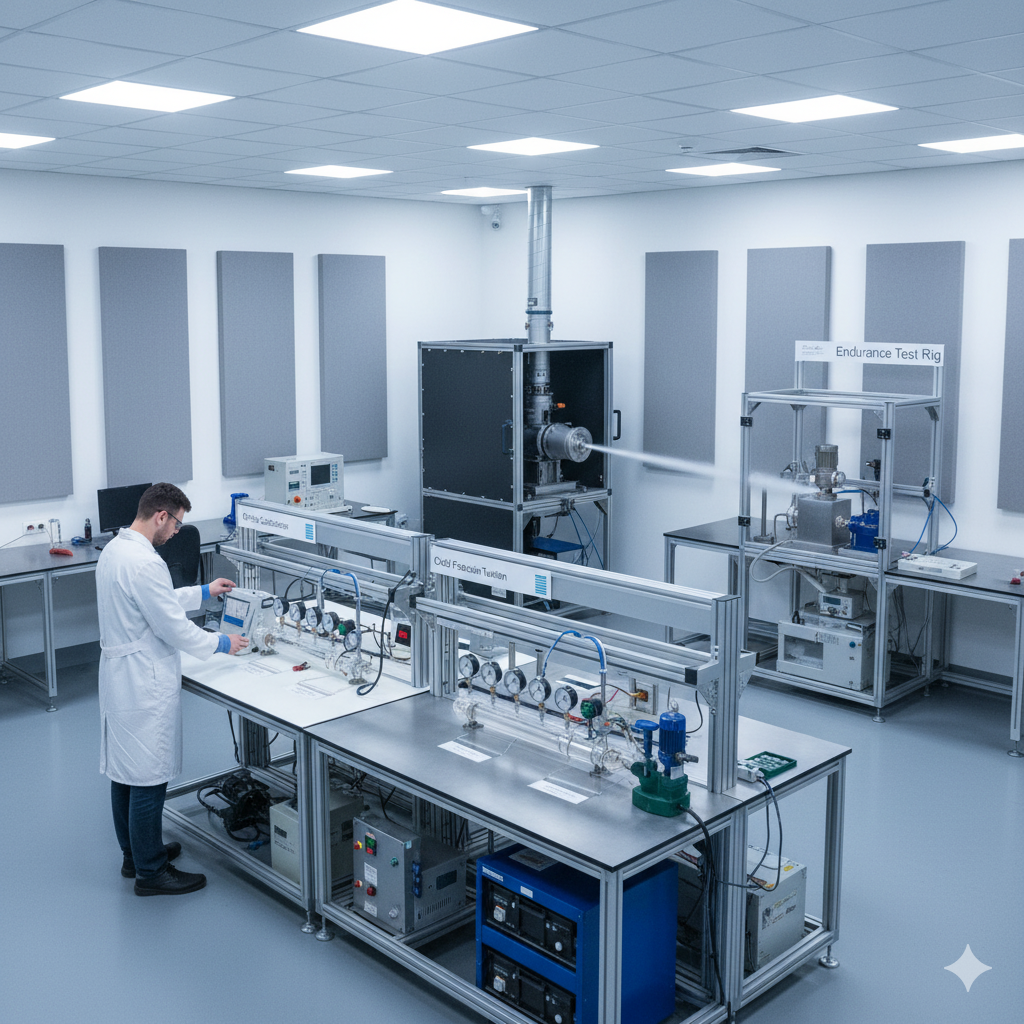
For Pakistani OEMs, integrators, and large end users, we offer complete technology transfer packages. These include process know-how for assembly and quality control, equipment specifications for airflow testing rigs and leak checks, operator and maintenance training curricula, and documentation suites ready for ISO audits. Where strategic, we undertake factory establishment services, from feasibility studies and facility layouts to pilot-line commissioning and performance validation, enabling local assembly or co-manufacturing with short lead times and PKR cost visibility.
Quality control is non-negotiable. We deploy control plans anchored in international standards, with incoming inspection, dimensional checks, pressure and flow verification, and stress tests for fittings and seals. Our team provides ongoing technical support, root-cause analysis if anomalies arise, and continuous process optimization based on field data from Pakistani plants. This is the same comprehensive, long-term partnership approach that has delivered superior outcomes for more than 19 enterprises worldwide, often reflected in higher OEE, reduced scrap, and faster payback than off-the-shelf alternatives.
Future market opportunities and 2025+ trends: energy, digitalization, and resilient operations
Looking ahead, three trends will shape Pakistan’s industrial cooling needs. First, energy efficiency will be measured more rigorously as plants adopt ISO 50001 frameworks and utilities incentivize demand management. Cold air systems will need transparent air consumption metrics and smarter controls; Sicarbtech is already piloting flow controllers and duty-cycle logic to cut compressed air use without sacrificing cooling performance.
Second, digitalization will push condition monitoring into more workcells and cabinets. As predictive maintenance programs expand, thermal baselines from thermal cameras and smart sensors will flag hotspots before failures occur. Cold air tubes integrated with simple flow sensors and line pressure monitors will become part of a broader reliability stack, enabling data-driven adjustments during heatwaves or peak shifts.
Third, resilience to ambient extremes and dust will carry greater weight. With climate variability, months of elevated temperatures will stress electronics and sensors longer each year. Dry, clean, targeted cooling that does not invite dust will outperform fan-only strategies. Moreover, for heavy industries where sparks, fines, and fumes are persistent, non-electrical cooling devices offer intrinsic safety advantages.
Sicarbtech’s roadmap merges these realities: robust mechanics, measurable performance, and options for local assembly and service. This combination makes cold air tubes not just a stopgap for summer, but a year-round reliability tool aligned with Pakistan’s competitiveness agenda.
Frequently asked questions
How much compressed air do Sicarbtech cold air tubes consume in typical Pakistani plants?
Consumption varies by model and cold fraction setting, but most spot cooling configurations run in the 200–500 L/min range at 6–7 bar. Enclosure coolers can be sized from 300–900 L/min depending on cabinet volume and heat load. We size systems after a quick survey of your air headers, dew point, and duty cycle.
Will cold air tubes reduce dust ingress into control cabinets?
Yes. Enclosure cold air coolers maintain positive pressure with dry air, allowing the cabinet to stay closed and preserving its IP rating. This prevents the lint and cement dust accumulation that open-door fan setups often cause.
Are cold air tubes noisy, and how do you mitigate sound in shop floors?
Vortex devices can be loud without silencers. Sicarbtech includes high-efficiency silencers and, where required, remote exhaust routing. We balance cooling performance with sound management to align with workplace safety guidelines.
How do cold air tubes compare to installing small AC units on cabinets?
AC units need electrical power, regular filter changes, and struggle in dusty spaces unless well-maintained. Vortex enclosure coolers are simpler, have no moving parts, and provide dry air. The better choice depends on ambient conditions, dust levels, and maintenance capacity; we often see vortex coolers winning in harsh, dusty environments.
Can I use existing plant compressed air without affecting pneumatic tools?
Usually yes, provided the line capacity and dryers are adequate. We measure pressure at point-of-use and recommend regulators and accumulators if needed. Duty-cycle control further reduces air draw during low-heat periods.
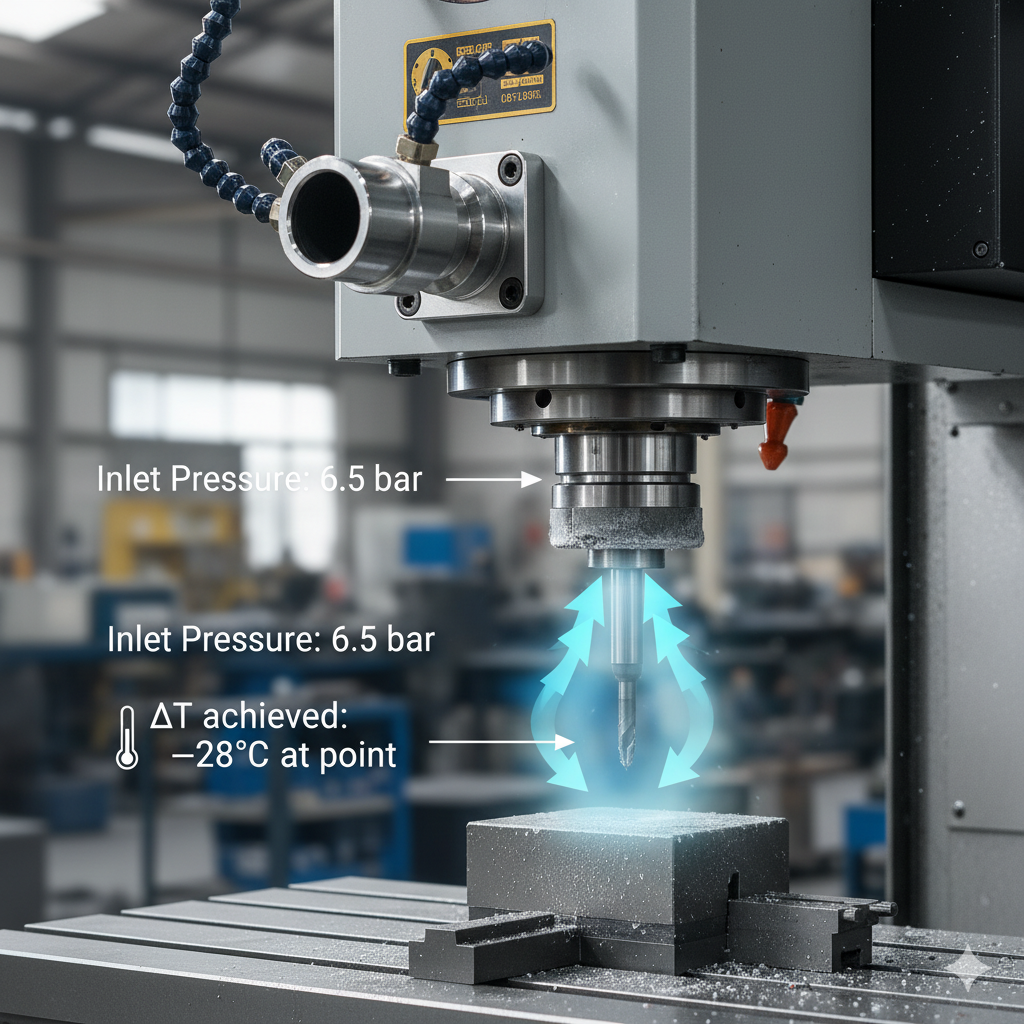
What temperature drop can I expect at the cutting zone on a CNC?
With stable 6.5 bar inlet pressure and proper nozzle targeting, a 20–35°C drop at the tool tip is typical, sometimes higher for small, focused zones. Results depend on heat load, chip evacuation, and airflow geometry.
Do Sicarbtech solutions help in welding cells without disturbing shielding gas?
We use directional nozzles and brackets to keep the cold air away from the weld pool and shielding envelope, cooling sensors and fixtures rather than the arc zone. Trials on your cell determine the safe offset distance and angle.
What documentation does Sicarbtech provide for ISO audits?
Installation SOPs, pressure and flow baselines, maintenance checks, and as-built specifications. For plants pursuing ISO 50001, we provide guidance to log compressed air usage and correlate with thermal performance.
Can Sicarbtech support local assembly or joint manufacturing in Pakistan?
Yes. Through our technology transfer program, we share process know-how, inspection methods, and equipment specifications, and we can assist with facility setup and training to localize assembly with consistent quality.
What is the typical payback period?
In hot zones causing frequent trips, payback can be under 12 months, often within 6–10 months when downtime penalties and scrap reduction are included. We develop a site-specific ROI model reflecting PKR costs and your production schedule.
Making the right choice: align cooling strategy with uptime, quality, and energy goals
Choosing between fans, liquid cooling, and vortex cold air tubes is a strategic decision about reliability, cleanliness, and total cost. If your shop floor is dusty, ambient temperatures spike above 40°C, and cabinets or sensors are responsible for frequent micro-stoppages, cold air tubes and enclosure coolers offer an elegant, low-maintenance solution that aligns with ISO-managed operations. By engaging Sicarbtech early, you turn cooling into a measurable reliability lever: right-size air consumption, stabilize temperatures at the point of risk, and document improvements that satisfy both production and audit teams.
Get expert consultation and custom solutions
Speak with Sicarbtech’s engineering team to audit heat hotspots, assess compressed air capacity, and design a tailored cooling strategy for your lines. We bring the rigor of advanced manufacturing from Weifang and the practicality of field-proven deployments to Pakistan’s textile, cement, steel, and emerging sectors. Share your cabinet layouts, CNC cell photos, or packer schematics, and we will propose a fast, defensible path to higher uptime.
Sicarbtech — Silicon Carbide Solutions Expert
[email protected]
+86 133 6536 0038
Article metadata
Last updated: 2025-10-28
Next review scheduled: 2026-01-28
Freshness indicators: pricing ranges aligned with 2024–2025 Pakistani market data; energy and compressed air cost models reviewed quarterly; compliance references consistent with ISO 9001/14001/45001 practices and local safety norms.

About the Author – Mr.Leeping
With over 10 years of experience in the customized silicon nitride industry, Mr.Leeping has contributed to 100+ domestic and international projects, including silicon carbide product customization, turnkey factory solutions, training programs, and equipment design. Having authored more than 600 industry-focused articles, Mr.Leeping brings deep expertise and insights to the field.
Customizable
successful cases
Related Post
-
Industrial Silicon Carbide Solutions for Pakistan’s High-Temperature and Abrasive Applications
Executive summary: 2025 outlook for silicon carbide solutions in Pakistan’s textile, cement, and steel industries Pakistan’s industrial economy heads into 2025 balancing cost pressure, energy constraints, and increasingly stringent quality and safety expectations. Textile mills in Punjab and Sindh are modernizing heat-setting, singeing, and stenter lines while optimizing gas consumption. Cement plants across Punjab and…
-

Hastelloy Cantilever Impellers for Industrial Pumps in Pakistan
Executive overview: 2025 outlook for corrosion‑resistant pump performance in Pakistan’s process industries Pakistan’s industrial base is entering a decisive phase in 2025. Volatility in energy pricing, mounting water‑treatment demands, and tighter environmental enforcement are converging with export‑driven growth in textiles and a sustained clinker output in cement. Across these sectors, unplanned downtime is increasingly expensive…
-

Annular Support Solutions with Silicon Carbide for Enhanced Thermal Stability in Pakistan’s Industry
Executive Overview: Why 2025 Demands Heat-Resistant Annular Supports Built with Silicon Carbide Pakistan’s industrial base is stepping into 2025 with tighter energy margins, higher fuel costs, and increasingly stringent quality and safety expectations across textile, cement, steel, and adjacent process sectors. Textile dyeing and finishing lines are raising bath temperatures and cycling faster to meet…