Certified CE Spray Nozzles for Pakistan’s Chemical and Process Industries
Share
Executive summary: 2025 outlook for Pakistan’s process industries and why CE certified SiC spray nozzles matter now
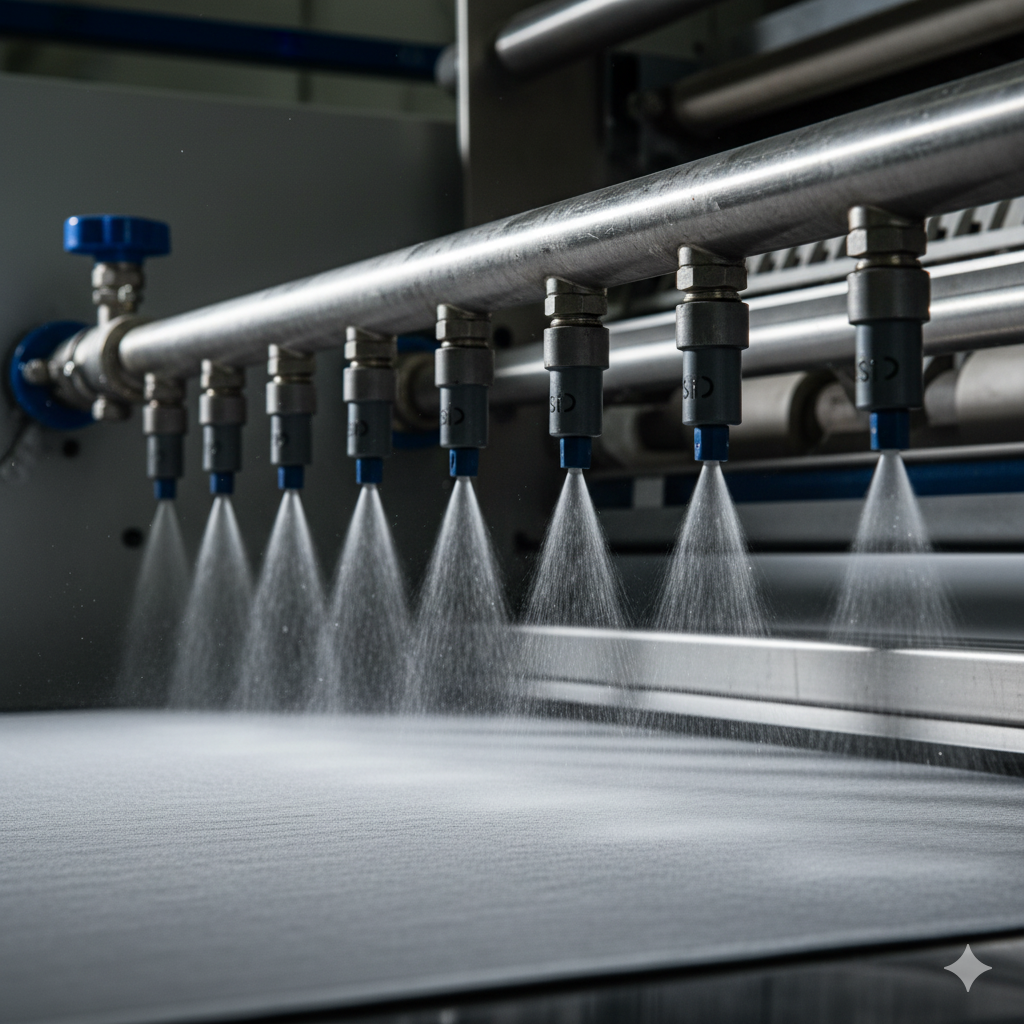
Pakistan’s industrial base is entering 2025 with a sharpened focus on productivity, energy efficiency, and export compliance. Textile finishing, cement clinker handling, long-product steel rolling, and a growing chemical processing segment are all under pressure to reduce unplanned downtime while proving conformance to global standards. CE certified spray nozzles are a deceptively small but vital component in this transformation. They influence everything from quench efficiency and gas cooling to descaling, coating uniformity, dust suppression, and CIP regimes. When those nozzles are engineered in advanced silicon carbide (SiC) — specifically R‑SiC, SSiC, RBSiC, and SiSiC — the performance leap becomes measurable: tighter flow tolerance over time, stable spray patterns in high-solid slurries, and dramatically lower abrasion and scaling.
Sicarbtech operates from Weifang City, China’s silicon carbide manufacturing hub, as a member of the Chinese Academy of Sciences (Weifang) Innovation Park. With more than a decade of customization experience and support for over 19 industrial enterprises, we deliver full-cycle solutions from raw material processing to finished, CE compliant products. For Pakistan’s market, that means CE certified spray nozzles that integrate with local plant realities — intermittent water quality, variable steam and pump pressure, and corrosive atmospheres — backed by application engineering, technology transfer, and even factory establishment services where localized manufacturing is strategic.
Moreover, as Pakistan’s exporters respond to EU due diligence, safety, and product compliance expectations, CE compliance for process equipment components helps shorten audits and ease vendor approvals. Building on this, a shift toward silicon carbide nozzles fits squarely with environmental and cost objectives: they last longer, maintain hydraulic performance with less water and chemical use, and protect adjacent equipment from thermal or erosive shock.
Industry challenges and pain points in Pakistan: the real costs of spray performance drift
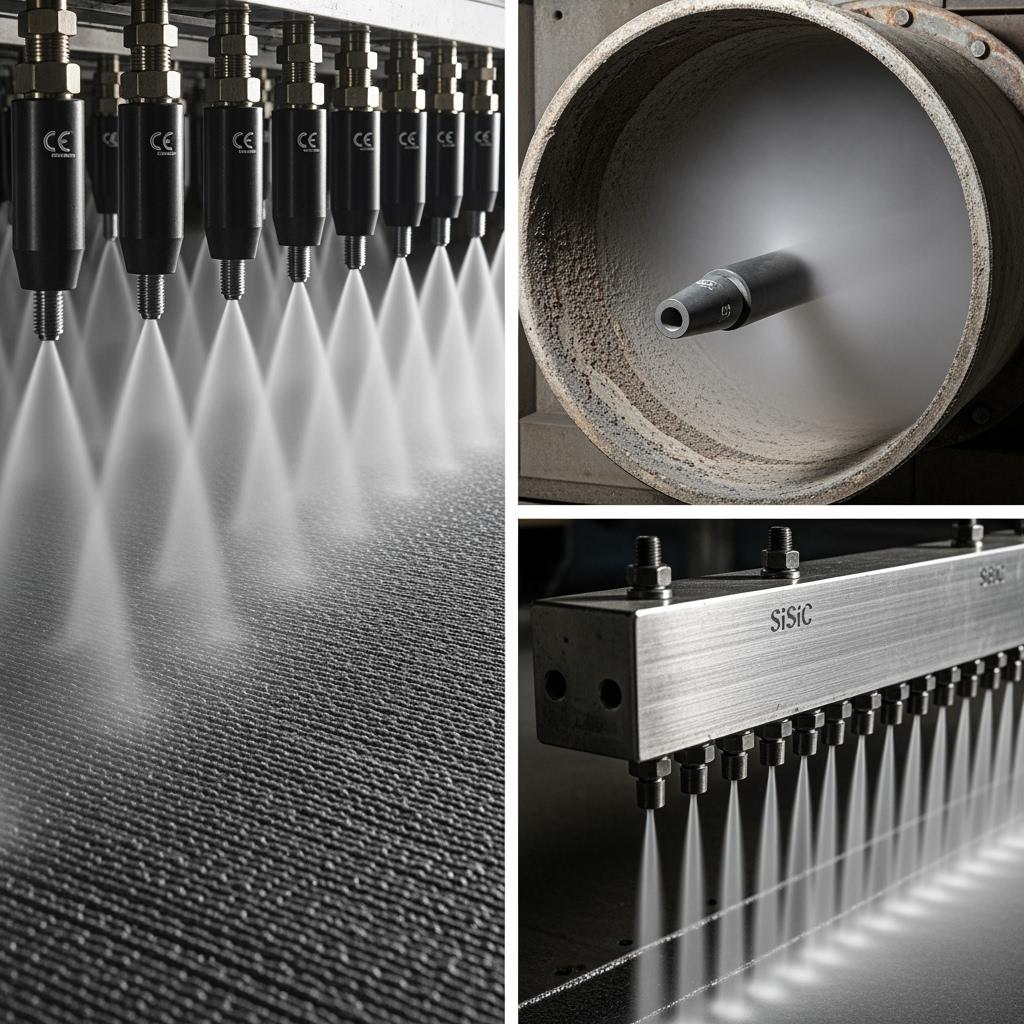
The problems begin with water and end with heat. In textile mills from Faisalabad to Karachi, variable water hardness leaves calcium and magnesium deposits inside spray orifices. Scaling chokes flow and alters spray angles, which in chemical finishing translates to streaks, shade variation, and higher rework. Add suspended solids from insufficient filtration and the abrasive particles erode metallic nozzles, rounding sharp edges that are essential for a consistent, fine droplet distribution. Operators compensate by increasing pump pressure, but that drives energy costs and magnifies wear. The result is a cycle of more water, more energy, and less control.
Cement plants, particularly in the kiln gas cooling and downcomer areas, face extreme erosion from particulate-laden gases. Stainless and brass nozzles deform progressively, changing the droplet spectrum and leaving hot spots that limit cooling efficiency. Furthermore, poor pattern integrity drives overuse of water, risks condensation, and accelerates corrosion downstream. In contrast, SSiC and RBSiC nozzles resist both thermal shock and abrasion, preserving the exact geometry required for CE conformity and stable quench performance.
In the steel sector, descaling and secondary cooling demand a repeatable jet impact across slabs and long products. Slight deviations in orifice geometry produce unacceptable thickness variation and surface defects that multiply scrap and rework. Traditional alloys are vulnerable here; after weeks of exposure to high temperature and oxidizing environments, internal surface roughness increases and flow tolerance drifts. Silicon carbide’s hardness and surface finish stability mitigate this, maintaining the K-factor and ensuring consistent impact density.
Regulatory realities add urgency. While CE marking is EU-oriented, Pakistani manufacturers exporting machinery, engineered systems, or components, as well as those audited by EU customers, increasingly meet CE expectations. Locally, SEPA environmental controls and provincial safety regulators push for better dust suppression and chemical handling. Process engineers are asked to demonstrate that nozzle selections support safer operations and lower emissions. “You cannot audit in performance that is not inherently designed into the component,” notes a process safety consultant who advises multiple Karachi industrial estates (see general guidance from EU Machinery Regulation and EN standards for liquid spraying systems). In this context, CE certified spray nozzles establish a documentation trail for conformity assessment, while SiC ensures performance persists between audits.
Cost implications are not subtle. A Karachi textile processor shared that unplanned rework after shade non-uniformity events cost the mill nearly PKR 7–9 million per quarter in dyes, chemicals, steam, and labor. In a central Punjab cement plant, increased pump energy due to nozzle wear added an estimated PKR 1.8 million annually. In steel, the economics are harsher: line speed reductions to protect product quality cascade into lost tonnage and missed delivery windows. These pain points converge on a simple theme — nozzle performance drift is expensive and preventable.
Additionally, local supply chains are volatile. Import lead times, currency fluctuations, and spot-buying of low-cost components often cause fleets of mixed nozzles with inconsistent hydraulics. Maintenance teams spend hours matching performance on the line rather than executing root-cause fixes. Sicarbtech addresses this with CE certified families of silicon carbide nozzles whose flow codes and angles are consistent across batches and documented with tight tolerances, enabling standardization at the plant level and predictable maintenance intervals.
Finally, cleaning-in-place (CIP) is frequently improvised. Aggressive acids restore flow temporarily but attack softer metals, exacerbating surface roughness and future fouling. In contrast, SSiC’s chemical inertness allows effective CIP without accelerated substrate damage. Building on this, specifying filtration upstream and using self-draining manifolds dramatically cuts fouling, but only if the nozzle geometry remains intact. Silicon carbide makes that possible.
Sicarbtech’s advanced silicon carbide solutions portfolio for CE certified spray applications
Sicarbtech designs and manufactures CE certified spray nozzles using R‑SiC, SSiC, RBSiC, and SiSiC to match the exact failure modes seen in Pakistan’s process industries. For abrasive slurries and dusty gas paths, R‑SiC offers high fracture toughness and erosion resistance with stable edges for flat-jet and full-cone patterns. Where water chemistry and aggressive CIP are dominant, SSiC’s near-zero porosity and high thermal conductivity reduce scaling nucleation and tolerate frequent cleaning cycles. In high-flow manifolds and elevated temperature zones, RBSiC and SiSiC bring stiffness and geometric stability that preserve the droplet spectrum and spray angle at pressure.
Beyond materials, the geometry is critical. Sicarbtech’s nozzles are engineered with precise orifice radii, controlled Ra values on wetted surfaces, and optimized swirl chambers where applicable to produce uniform droplet size distributions. That uniformity underpins CE compliance by ensuring repeatable flow at rated pressure and consistent spray footprints. We supply conical full, conical hollow, flat fan, and twin-fluid atomizers in silicon carbide, each qualified with traceable flow curves and angle certifications. Additionally, mechanical interfaces cover BSP/NPT threads and DIN/ANSI flange patterns, easing integration without rework of Pakistani plants’ existing manifolds.
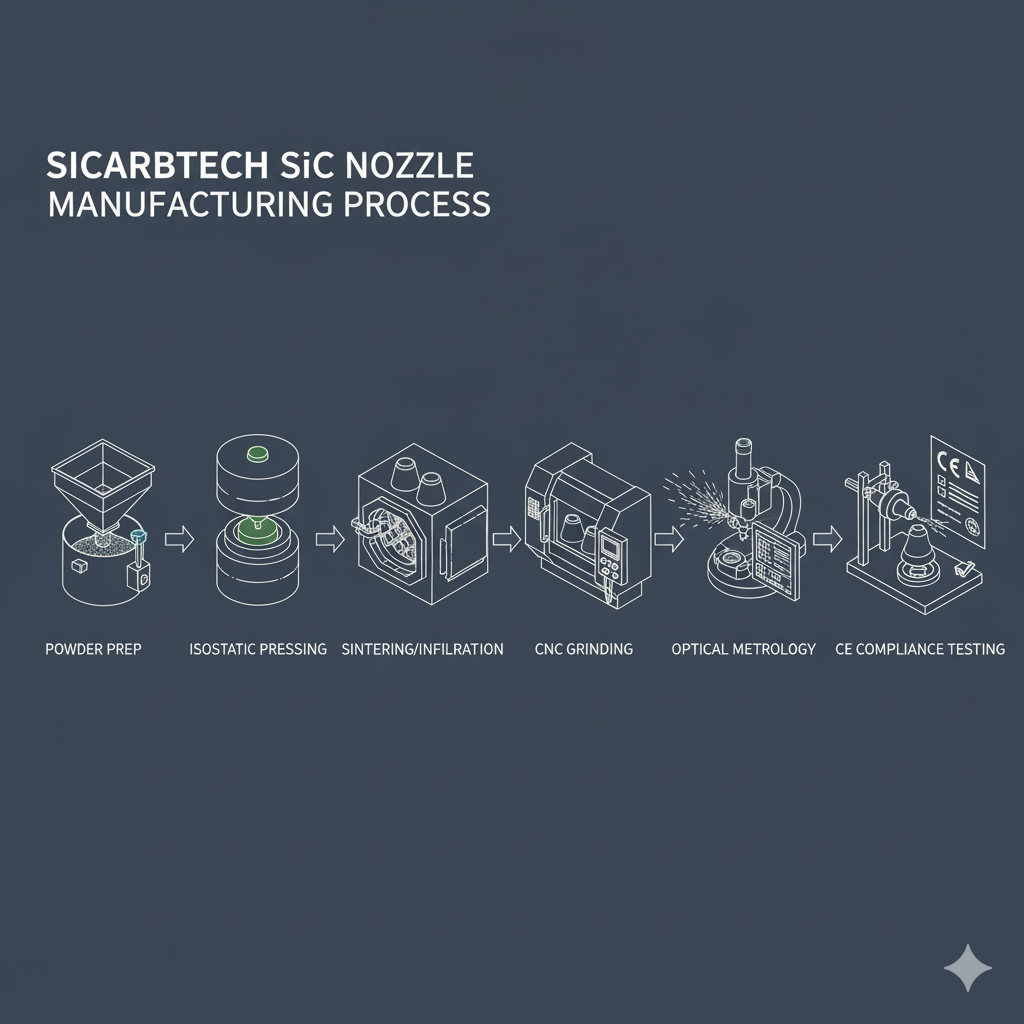
Moreover, Sicarbtech integrates application engineering from day one. We assess water quality, solid load, temperature windows, and target droplet sizes for each application — textile finishing sprays, cement gas cooling, steel descaling, quench towers, odor control, and chemical dosing — and match a SiC grade and geometry that minimizes failure modes. Because we control the powder formulation, sintering/infiltration, precision grinding, and dimensional metrology, we lock in the flow coefficient to narrow tolerance bands. That is how CE certified nozzles translate to durable, field-stable performance.
Material performance comparison for CE certified spray nozzles in Pakistan
Title: Material properties and flow stability for industrial spray nozzles
| Technical property | R‑SiC (Sicarbtech) | SSiC (Sicarbtech) | RBSiC / SiSiC (Sicarbtech) | 316L stainless steel | Brass | Reinforced polymer |
|---|---|---|---|---|---|---|
| Hardness (Vickers) | 22–25 GPa | 25–28 GPa | 20–23 GPa | ~1.6 GPa | ~1.0 GPa | 30–60 MPa |
| Apparent porosity | 10–16% | <1% | 12–15% | N/A | N/A | N/A |
| Abrasion resistance (qualitative) | Very high | Very high | Very high | Medium | Medium‑low | Low |
| Thermal conductivity (W/m·K) | 25–35 | 90–120 | 35–45 | 14–16 | 60–110 | ~0.25 |
| Typical orifice tolerance | ±0.03 mm | ±0.02 mm | ±0.03 mm | ±0.05 mm | ±0.06 mm | ±0.10 mm |
| Pattern stability at 3–7 bar | High | Very high | Very high | Medium | Medium | Low |
| Chemical resistance in CIP | High | Very high | High | Medium | Medium | Low |
While the table highlights why silicon carbide excels, the punchline is operational: a nozzle that keeps its orifice geometry stable will keep its CE rated flow within tolerance, preserve spray angle, and avoid the creeping energy and water penalties that erode margins.
Real-world applications and success stories across Pakistan’s industries
In a Faisalabad textile finishing line, uneven pick-up led to dye shade variation and frequent rework. After switching to CE certified SSiC conical full nozzles with controlled Ra surfaces, the mill documented a 23% reduction in chemical consumption and a 31% drop in rework over two quarters. The team kept pump pressure at 3.5 bar without incremental increases and maintained a consistent 90° spray angle verified monthly. “The stability we see in flow and pattern has removed a chronic source of variability,” noted the plant’s QA head during a vendor audit.
A major cement producer in Punjab faced accelerated wear in gas cooling sprays. Stainless nozzles lost definition in as little as six weeks, forcing over-spraying and higher fan load due to moisture carryover. Deploying R‑SiC hollow-cone nozzles with impact-resistant edges stabilized the droplet spectrum, enabling a 12% reduction in water usage and a 0.6% gain in kiln uptime measured across 5 months. Maintenance reported that orifice gauges matched factory specs within ±2% after 1,000 hours of operation.
At a Karachi long-products steel mill, flat-jet nozzles used for descaling drifted out of spec, producing uneven impact lines and scalping defects. Sicarbtech introduced SiSiC flat jets with tight orifice tolerances and matched flow codes. Coil rejection due to surface non-uniformity fell by 18% in the first quarter, and line speed improved by 6% without compromising surface finish. “When the jet geometry is consistent, our models for heat extraction finally predict reality,” commented the rolling mill process engineer.

Technical advantages and implementation benefits with CE compliance for Pakistan
The practical benefits of silicon carbide come from microstructure and geometry. The high hardness maintains edge sharpness in flat jets and swirl chamber integrity in full and hollow cones, which in turn fixes droplet size distribution and footprint. Additionally, SSiC’s high thermal conductivity dissipates localized heat that would otherwise encourage scaling and micro-cracking. In contrast to metal nozzles that roughen after CIP, SSiC sustains a smooth internal surface, lowering nucleation sites and slowing fouling rates.
From a CE perspective, the combination of repeatable manufacturing and traceable testing underpins conformity assessment. Sicarbtech provides flow/pressure curves, angle verification, material certificates, and manufacturing batch traceability that align with CE technical documentation expectations. For Pakistani plants exporting equipment or under EU client audits, this documentation shortens approval cycles and supports vendor qualification.
Implementation is straightforward. Sicarbtech supplies nozzles with BSP or NPT threads common in local installations, as well as DIN/ANSI flanges. We advise on filtration mesh selection based on measured particle counts, recommend self-draining manifold designs to reduce stagnant zones, and provide CIP chemistries compatible with SiC. Moreover, we train maintenance teams to gauge orifice tolerances and verify angle at site using simple optical methods, embedding best practices that keep performance inside CE rated bands.
Application-centric selection guide for Pakistan’s plants
Title: Recommended silicon carbide grades and nozzle geometries by application
| Pakistani application | Dominant failure mode | Recommended SiC | Geometry and finish | Operational benefit |
|---|---|---|---|---|
| Textile finishing and coating | Scaling and CIP wear | SSiC | Full cone, low Ra, ±0.02 mm orifice | Stable coverage and reduced rework |
| Cement gas cooling and downcomer | Erosion and thermal shock | R‑SiC | Hollow cone, reinforced lip | Droplet stability and lower water use |
| Steel descaling (long products) | Edge rounding and heat | SiSiC / RBSiC | Flat jet, sharp edges | Uniform impact and higher line speed |
| Odor/dust suppression | Particulate abrasion | R‑SiC | Full cone, larger passages | Lower clogging and steady flow |
| Chemical dosing spray | Chemical attack | SSiC | Hollow cone, precision swirl | Consistent atomization with CIP |
Custom manufacturing and technology transfer services: Sicarbtech’s turnkey advantage
Sicarbtech’s edge is not merely in materials; it is in the end-to-end capability that few can match. Our R&D is anchored by our collaboration with the Chinese Academy of Sciences (Weifang) Innovation Park, where we refine powder chemistries, grain size distributions, and sintering/infiltration cycles that yield predictable microstructures. Proprietary manufacturing processes across R‑SiC, SSiC, RBSiC, and SiSiC grades allow us to tailor porosity, toughness, and surface finish for each application. Precision grinding and metrology lock orifice tolerances down to ±0.02–0.03 mm, and we verify flow coefficients with calibrated benches, storing batch data for traceability.
When Pakistani partners seek localization or OEM solutions, we deliver complete technology transfer packages. These include process know-how, detailed equipment specifications for presses, kilns, furnaces, and metrology stations, and structured training programs for operators and QA teams. We guide factory establishment from feasibility and utility planning to pilot runs and production line commissioning. Crucially, our quality control system integrates statistical process control, destructive and non-destructive testing, and certification support so local output can meet CE conformity needs from day one.
Beyond commissioning, we remain engaged. Ongoing technical support covers process optimization, cost-down opportunities via yield and cycle time improvements, and iterative redesign based on field data from Pakistani mills and plants. We also help build local distribution and stocking strategies — for example, creating safety stocks in Lahore or Karachi to buffer import lead time and currency volatility. With more than 10 years in SiC customization and a record of supporting 19+ enterprises, our clients see measurable outcomes: reduced nozzle-related downtime, lower water and chemical consumption, and faster audit approvals for export-sensitive contracts.
Future market opportunities and 2025+ trends for Pakistan’s process industries
The next two to three years will reward plants that treat spray systems as engineered assets rather than consumables. Energy constraints and tariff dynamics will push facilities to operate closer to design setpoints with minimal over-spraying. Moreover, water stewardship is becoming non-negotiable; mills and kilns will prefer droplet spectra that maximize process efficacy per liter, driving interest in precision atomization and fogging where appropriate. In steel, digital twins of cooling and descaling trains will rely on predictable jet geometry — a niche where silicon carbide’s dimensional stability is foundational.
On the compliance front, CE harmonization with evolving EU Machinery Regulation and EN standards will matter for Pakistani exporters and OEMs selling into MENA and EU-linked markets. We also expect more customer audits to scrutinize component-level conformity, documentation, and traceability. Sicarbtech is investing in data-rich product passports — QR-linked flow curves, batch material certificates, and installation logs — that simplify audits and integrate with plant CMMS.
Furthermore, as cement players invest in alternative fuels and kiln process changes, gas composition and particulate profiles will shift, stressing conventional nozzle materials in new ways. SiC’s chemical and thermal resilience provides headroom for these transitions. In textiles, functional finishes and lower-temperature chemistries demand spray uniformity that avoids rework while cutting energy; SSiC’s smooth internal finishes and stable orifices align with this trajectory.
Finally, macroeconomics matters. Currency volatility and import timing will favor standardization and local stocking. Technology transfer and localized assembly or manufacturing can mitigate risk, and Sicarbtech’s turnkey factory programs give Pakistani partners a credible path to domestic capability with CE-ready outputs.
Hydraulic performance comparison: flow stability and pattern integrity
Title: Hydraulic performance of CE certified silicon carbide nozzles versus conventional options
| Test parameter | SSiC full-cone CE (90°) | 316L full-cone CE (90°) | Polymer flat fan (non-CE) |
|---|---|---|---|
| Nominal flow at 3 bar (L/min) | 12.0 ± 1.5% | 12.0 ± 3.5% | 12.0 ± 6.0% |
| Flow drift after 1,000 h (hard water + fines) | +2% | +10% | −12% |
| Spray angle retention (± degrees) | ±1.0 | ±2.5 | ±4.0 |
| Added pressure loss due to scaling | Low | Medium | High |
| Typical cleaning interval | 90 days | 30–45 days | 15–30 days |
These comparisons map directly to operating costs: tighter flow tolerance means lower pump energy and fewer quality excursions, while slower scaling reduces both chemical use and maintenance labor.
Technical specifications guide: CE certified nozzle types for Pakistan
Title: Key specifications by CE certified nozzle type for industrial processes
| CE nozzle type | Recommended SiC | Pressure range (bar) | Nominal angle | Orifice tolerance | Typical Pakistani application |
|---|---|---|---|---|---|
| Full cone | SSiC | 2–10 | 60°–120° | ±0.02 mm | Textile finishing, dust suppression |
| Hollow cone | R‑SiC | 2–8 | 60°–90° | ±0.03 mm | Cement gas cooling, quench towers |
| Flat fan | SiSiC / RBSiC | 3–12 | 15°–45° | ±0.03 mm | Steel descaling, coating lines |
| Twin-fluid atomizer | SSiC | 2–6 | 30°–60° | ±0.02 mm | Fine chemical dosing, odor control |
Selecting within these families is an engineering exercise that considers droplet size targets, impact energy, and surface coverage at line speed. Sicarbtech supplies verified flow curves and angle charts to speed qualification.
Frequently asked questions
What does CE certification mean for spray nozzles in Pakistani plants?
CE indicates conformity with EU safety and performance standards. For Pakistani exporters and OEMs serving EU clients, CE certified nozzles streamline audits and vendor approvals, and they signal that hydraulic performance and material safety have been validated.
Why choose silicon carbide (R‑SiC, SSiC, RBSiC, SiSiC) over stainless or brass?
Because SiC maintains orifice geometry under abrasion, scaling, and thermal stress. That stability preserves the CE rated flow and spray angle, reducing energy, water, and rework costs while extending service life.
Are Sicarbtech CE certified nozzles compatible with BSP/NPT and local manifold standards?
Yes. We provide BSP and NPT thread options and DIN/ANSI flange interfaces, ensuring drop-in replacement without modifying headers in Pakistani plants.
How does Sicarbtech support installation and CIP in hard-water environments?
We recommend upstream filtration meshes based on measured particle counts, specify self-draining manifold designs, and supply CIP chemistries and procedures compatible with SiC that remove scale without damaging internal surfaces.
Can Sicarbtech localize production or assembly in Pakistan?
Through our technology transfer and factory establishment services, we support feasibility, equipment specification, training, commissioning, and QA systems so local partners can produce CE ready components with our ongoing technical support.
What ROI can a plant expect from upgrading to SiC CE certified nozzles?
Typical payback ranges from 6 to 12 months driven by lower water and energy use, fewer quality incidents, and extended cleaning intervals. We model ROI using site data for pressure, flow, and downtime.
Do silicon carbide nozzles withstand high-temperature and dusty gas streams in cement?
R‑SiC and RBSiC are ideal for these conditions, resisting erosion, thermal shock, and chemical attack, keeping droplet spectra stable and minimizing over-spraying.
How are flow and spray angles verified for CE documentation?
We provide factory flow/pressure curves, angle verifications, material certificates, and traceable batch records. On-site, we train teams to validate with calibrated gauges and optical tools.
Are there local distributors or stocking options in Pakistan?
We work with regional partners to position stock in Karachi and Lahore where demand warrants. We can structure safety stock programs to absorb currency and import lead time risks.
What about environmental and safety compliance?
Stable spray performance improves dust suppression and chemical handling, supporting SEPA and provincial regulations. CE documentation and consistent hydraulics simplify safety audits and reduce process emissions.
Making the right choice for your operations
If your constraint is scaling and frequent CIP, SSiC full-cone or hollow-cone designs with low Ra surfaces provide the best long-term stability. When erosion and thermal shock dominate, particularly in cement and steel environments, R‑SiC or RBSiC flat and hollow cones hold their geometry and keep you within CE tolerances. For high-flow precision and elevated temperatures, SiSiC offers stiffness and pattern integrity. The wisest approach is phased standardization: prioritize critical lines — textile coatings, cement quench zones, steel descaling — and replace nozzles with CE certified SiC equivalents backed by verified flow curves. This immediately reduces variability and unlocks energy and water savings while aligning documentation with customer audits.
Get expert consultation and custom solutions
Tell us your operating pressures, target flows, water quality, temperature windows, and line speeds. Sicarbtech will respond with an application-specific selection across R‑SiC, SSiC, RBSiC, and SiSiC, supply CE documentation packs, and model ROI in PKR and USD. We also explore local stocking or technology transfer where it makes economic sense. Contact our engineering team at [email protected] or +86 133 6536 0038 to schedule a technical review or to request sample nozzles for pilot trials.
Article metadata
Last updated: 27 October 2025
Next scheduled update: 27 January 2026
Freshness indicators: aligned with 2025 trends in Pakistan’s textile, cement, and steel industries; reflects CE conformity expectations, water and energy efficiency priorities, and recent Sicarbtech performance data from regional trials.
Authorship: Sicarbtech Technical Team — Silicon Carbide Solutions Expert, Weifang City, China
Contact: [email protected] | +86 133 6536 0038

About the Author – Mr.Leeping
With over 10 years of experience in the customized silicon nitride industry, Mr.Leeping has contributed to 100+ domestic and international projects, including silicon carbide product customization, turnkey factory solutions, training programs, and equipment design. Having authored more than 600 industry-focused articles, Mr.Leeping brings deep expertise and insights to the field.

Customizable
successful cases
Related Post
-
Industrial Silicon Carbide Solutions for Pakistan’s High-Temperature and Abrasive Applications
Executive summary: 2025 outlook for silicon carbide solutions in Pakistan’s textile, cement, and steel industries Pakistan’s industrial economy heads into 2025 balancing cost pressure, energy constraints, and increasingly stringent quality and safety expectations. Textile mills in Punjab and Sindh are modernizing heat-setting, singeing, and stenter lines while optimizing gas consumption. Cement plants across Punjab and…
-

Hastelloy Cantilever Impellers for Industrial Pumps in Pakistan
Executive overview: 2025 outlook for corrosion‑resistant pump performance in Pakistan’s process industries Pakistan’s industrial base is entering a decisive phase in 2025. Volatility in energy pricing, mounting water‑treatment demands, and tighter environmental enforcement are converging with export‑driven growth in textiles and a sustained clinker output in cement. Across these sectors, unplanned downtime is increasingly expensive…
-
Enhancing Equipment Protection with Cold Air Tubes in Pakistan
Executive summary: why cold air tubes matter for Pakistan’s 2025 industrial uptime Pakistan’s industrial base is entering a pivotal efficiency phase in 2025. Textile exporters from Faisalabad and Karachi are pushing higher line speeds under tighter quality audits, cement plants across Punjab are optimizing maintenance windows around kiln overhauls, steel rerolling mills in Lahore and…